Posts

OUT AND ABOUT WITHOUT A CAR: Taking the bus to Napa and beyond
Image
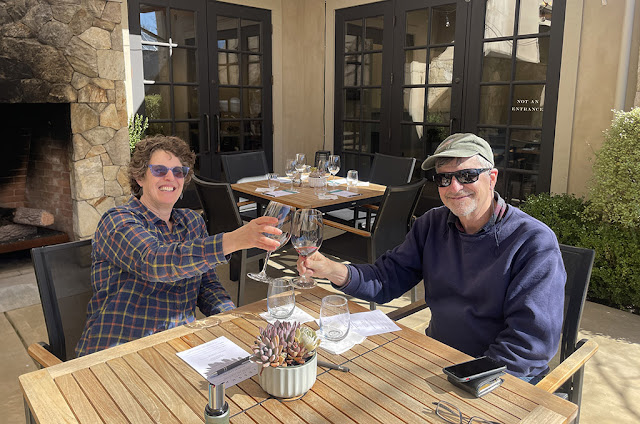
By Steve Price and Janet Byron Who knew that the wine country could be so accessible without a car? We walked over to El Cerrito Plaza BART, rode one stop to Del Norte BART, and then took Vine Transit buses to the wine country of Napa Valley. The bus ride to the city of Napa didn't take much longer than a car ride — less than an hour. It required a quick bus transfer in Napa to get downtown, and a short walk to our hotel in downtown Napa. Downtown Napa has densified in recent years, and the waterfront along the Napa River has multiuse trails, restaurants, and shops. It's pretty upscale—understandable considering that it's the gateway to the wine country. The next morning we took another Vine Transit bus to Yountville, where we wandered around the residential areas admiring the many houses with attractive porches and gardens. We walked by the famous French Laundry restaurant (too rich for our budget), then we shared a flight of three wine samples at Jessup Cellars (more affo...
Transportation vs. access-ation

Image
By Steve Price "Transportation" is a misnomer. When getting into a car or bus, most people are usually not transporting stuff. They travel in order to get themself to a destination: medical appointment, haircut, job, entertainment, meet friends, meetings . . . or to buy something. More often than not, their purchases are small, less than what you’d call “cargo.” The primary reason we travel is not "transport"-ation, it's for "access"-ation.  Transit planner Jarrett Walker explains in his book, Human Transit, that a primary purpose of transit is to provide people "access to opportunity." “Access is turning out to be a remarkably good predictor of ridership,” Walker says. We build transit systems not just to physically move people, but to deliver people to the things they want or need for living. They work best when transit goes in straight lines, not making lots of circuitous jogs. That way riders get to destinations directly and quickly, muc...

Bicycle riders flouting traffic rules; how big a problem?

Image
We often hear motorists complaining about bicycle riders flouting traffic laws. A Danish study put that notion to the test by analyzing video footage recorded at intersections. It found that 14% of bicycle riders violated traffic laws, but when separated bicycle lanes were present that number dropped to 4.9%. Interestingly, the study found that 66% of motorists violated traffic laws, and observations elsewhere in Europe confirm similar proportions.  In the United States’ more libertarian culture, the problem of lax respect for traffic laws is probably worse. It’s not uncommon to see motorists running red lights, speeding, rolling through stop signs, stopping on top of crosswalks, looking at phones while driving, and parking on top of bike lanes. Why are bicycle riders held to a higher standard? It could be that the unlawful behavior of motorists has become normalized and traffic enforcement has relaxed. Irresponsible behavior by bicycle riders is also easier to spot, such as ignori...

Ranking carbon emissions of urban transport modes

Image
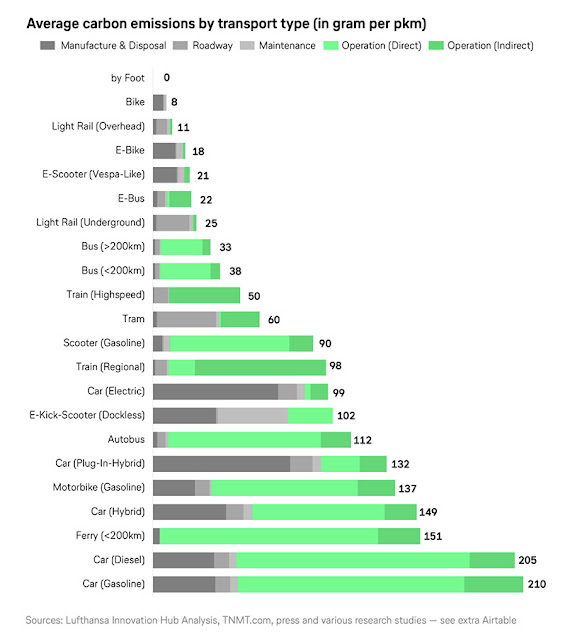
The chart above shows the relative greenhouse gas emissions for various transportation vehicles. TNMT, a data analysis group of the Lufthansa Innovation Hub aggregates data for the chart with the caveat that the numbers are not exact (for example, cars vary greatly in their gasoline consumption, but an average can be approximated). Emissions are often not obvious; for instance, a vehicle may have low emissions while driven, but the manufacturing of it may produce a lot. The chart is useful for making individual decisions as to vehicle choices or frequency of vehicle use. It shows that we can make big reductions in our carbon footprints if we are deliberate in our use of travel technologies. If we choose to use one for short errands and another for long-distance travel, that will be significantly beneficial. — Steve Price

Two-tier mobility

Image
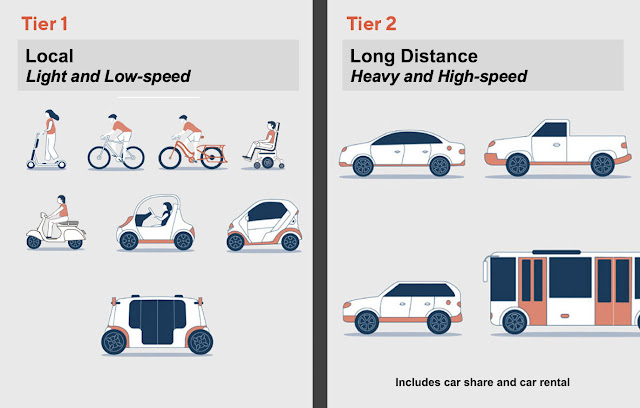
Illustration adapted from the book Near to Far by Dan Sturges. Modified with author's permission. By Steve Price The concept of “two-tier mobility” attempts to impose discipline on America's mobility habits, but in a way that acknowledges the value of full-size cars while being more discerning about their use in daily living. Tier 1 vehicles are bicycles, scooters, mopeds, neighborhood electric vehicles (NEVs), and an emerging class of small, autonomous shuttles transporting 8 to 12 passengers at slow speeds. Over 71 percent of travel in America is within a radius of 8 miles or less. This sweeps out an accessible area of over 200 square miles, depending on geographic constraints. Within this nearby but generous zone, seeking out a freeway for travel doesn't save much time. Some Tier 1 vehicles, such as e-mopeds and NEVs, can easily handle traveling 8 miles and back. About two-thirds of travel is 5 miles or less, which is easily done by bicycle. At 12 to 15 mph, that would ...

New rules for bike and pedestrian safety

Beginning January 1, 2024, bikes are allowed on most of the escalators throughout the BART system to help make it easier for people to bring their bikes on board the train. This change was approved by the BART Board of Directors at the request of Director Rebecca Saltzman, an El Cerrito resident. The vote authorizes further changes to BART’s bike rules, including allowing bikes on all train cars except the first car (bikes were previously banned from the first three cars during commute times), and allowing bicyclists to secure bikes on the train using the bike lean bar and straps, instead of holding them. Bikes will remain banned from BART’s 10 narrow escalators located at the 19th Street Oakland, Antioch, and Oakland Airport Connector stations. A video with safety tips for bringing bikes on escalators and the updated Bikes on BART rules are here . Bonus! Check out BART’s Elevator Dimension Guide for assistance with navigating BART elevators. Several new laws also went into effect in ...

El Cerrito sustainable transportation update

Image
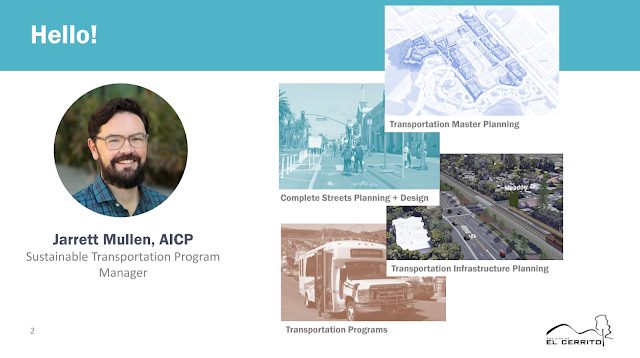
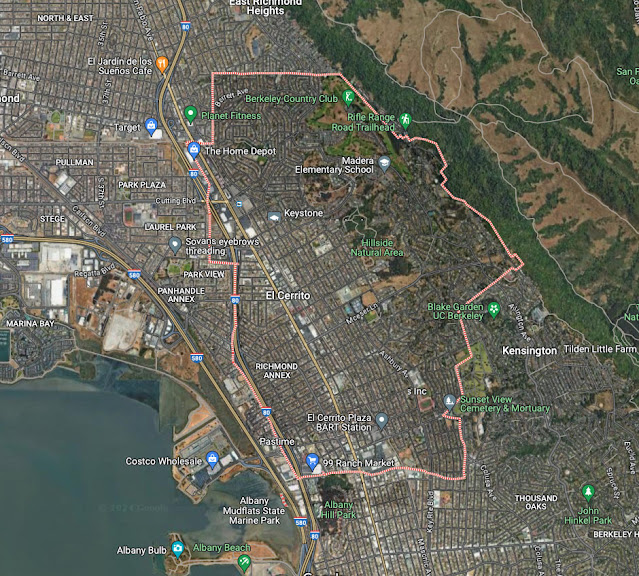
 At our Jan. 15 meeting, Jarrett Mullen, El Cerrito’s sustainable transportation manager, gave EC/RA Walk & Roll an update on current projects and future plans for improving multimobility around town. Mullen shared that the El Cerrito Public Works department filled two traffic engineering positions and secured $20+ million in transportation grants; the Del Norte Complete Streets program will break ground in March; a Local Road Safety Plan is underway; and the GIG CarShare pilot has been extended through 2024. Projects underway in 2024 include growing the city’s bicycle parking program and moving forward with the El Cerrito Plaza BART Station transit-oriented development project and BART’s Berkeley-El Cerrito Corridor Access Plan . Mullen’s presentation is here and the Zoom recording of his presentation and follow-up questions is here .