Posts

The growing micromobility market

Image
Mobility change is happening worldwide. In a new report , McKinsey & Company, a global management consulting firm, predicts big advances in the micromobility market between now and 2030. E-bikes are leading the way, especially in Europe. The majority of new bicycle sales in Germany and Netherlands are now for e-bikes. The United States as a whole may not be as robust in e-bike sales as Europe, yet our area is outside the norm, as seen around town. The growing number of electric cargo bikes is particularly noticeable. Now is the time to plan for El Cerrito and Richmond Annex's micromobility future. — Steve Price Top image: Micromobility, especially electric bicycles, is growing. Source: McKinsey & Company.
Should El Cerrito be a Vision Zero city?

Image
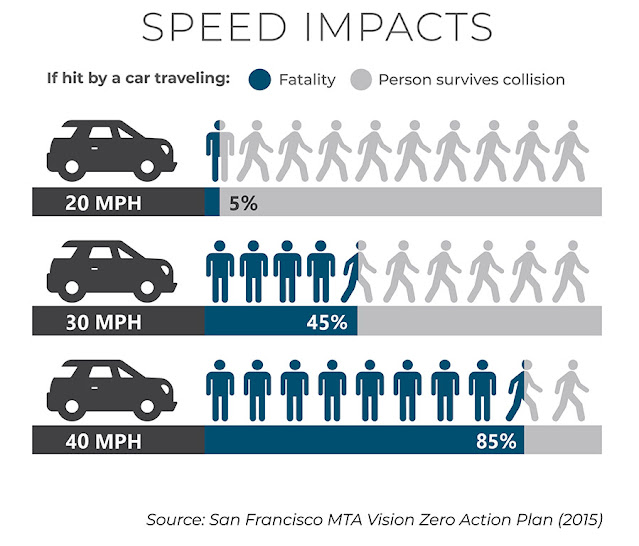
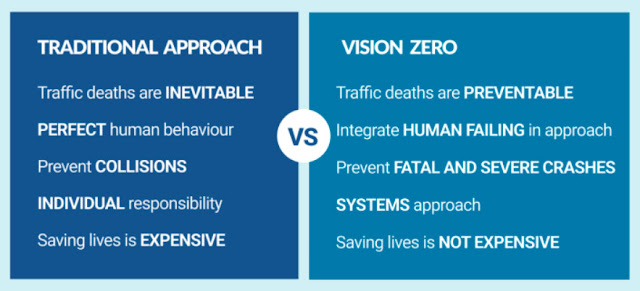
In its Local Road Safety Plan survey , El Cerrito asked participants whether the city should pursue becoming a Vision Zero city. Cities across the world, confronted by increasing fatality rates, are adopting Vision Zero and its Safe Systems Approach , with the ultimate goal of eliminating traffic-related fatalities and injuries on city streets by transforming how they are designed. In 2019, Berkeley became a Vision Zero city and adopted a plan with the goal “to eliminate traffic deaths and severe injuries on our city streets by 2028.” Hoboken, New Jersey , a city of 60,000 people, adopted a Vision Zero policy and hasn't had a traffic death in 4 years. Vision Zero is an international movement to increase street safety by changing how cities approach transportation. Presently our culture seems to believe that death and injury on our streets is just a price we pay for the convenience of automobility; the burden for making our streets safe is on the individual to drive safely, walk wi...

Take El Cerrito's Local Road Safety Plan survey

Image
Back in September we reported that El Cerrito was initiating work on a Local Road Safety Plan . With the help of transportation consultants Kittelson & Associates, the city achieved enough work on the plan to help with applying for street improvement grants. But recognizing that there is more that can be done, the city is refining the plan by asking locals to complete an El Cerrito Road Safety Questionnaire .  Let the city know about your traffic safety priorities! Question number 10 asks, “Should El Cerrito commit to being a Vision Zero City?” This commitment would help move our community toward safer streets and a multimodal transportation future in which all modes of mobility, no matter what speed, will be viable. And by making possible safe use of micromobility, El Cerrito will be better able to meet its goals of reducing community greenhouse gas emissions as envisioned in the Climate Action and Adaptation Plan .  If you have questions about the Local Road Safety Plan,...

OUT AND ABOUT WITHOUT A CAR: Taking the bus to Napa and beyond

Image
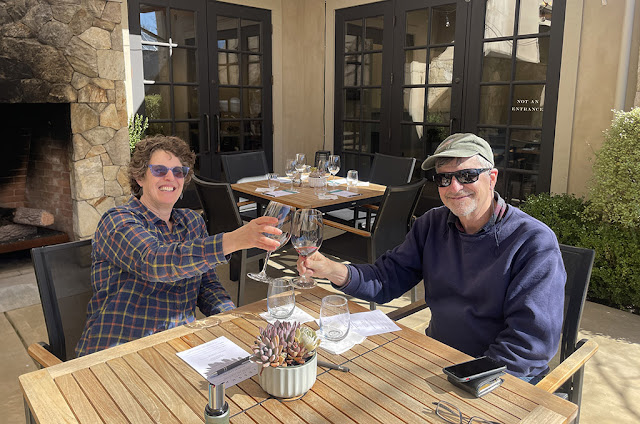
By Steve Price and Janet Byron Who knew that the wine country could be so accessible without a car? We walked over to El Cerrito Plaza BART, rode one stop to Del Norte BART, and then took Vine Transit buses to the wine country of Napa Valley. The bus ride to the city of Napa didn't take much longer than a car ride — less than an hour. It required a quick bus transfer in Napa to get downtown, and a short walk to our hotel in downtown Napa. Downtown Napa has densified in recent years, and the waterfront along the Napa River has multiuse trails, restaurants, and shops. It's pretty upscale—understandable considering that it's the gateway to the wine country. The next morning we took another Vine Transit bus to Yountville, where we wandered around the residential areas admiring the many houses with attractive porches and gardens. We walked by the famous French Laundry restaurant (too rich for our budget), then we shared a flight of three wine samples at Jessup Cellars (more affo...

Transportation vs. access-ation

Image
By Steve Price "Transportation" is a misnomer. When getting into a car or bus, most people are usually not transporting stuff. They travel in order to get themself to a destination: medical appointment, haircut, job, entertainment, meet friends, meetings . . . or to buy something. More often than not, their purchases are small, less than what you’d call “cargo.” The primary reason we travel is not "transport"-ation, it's for "access"-ation.  Transit planner Jarrett Walker explains in his book, Human Transit, that a primary purpose of transit is to provide people "access to opportunity." “Access is turning out to be a remarkably good predictor of ridership,” Walker says. We build transit systems not just to physically move people, but to deliver people to the things they want or need for living. They work best when transit goes in straight lines, not making lots of circuitous jogs. That way riders get to destinations directly and quickly, muc...

Bicycle riders flouting traffic rules; how big a problem?

Image
We often hear motorists complaining about bicycle riders flouting traffic laws. A Danish study put that notion to the test by analyzing video footage recorded at intersections. It found that 14% of bicycle riders violated traffic laws, but when separated bicycle lanes were present that number dropped to 4.9%. Interestingly, the study found that 66% of motorists violated traffic laws, and observations elsewhere in Europe confirm similar proportions.  In the United States’ more libertarian culture, the problem of lax respect for traffic laws is probably worse. It’s not uncommon to see motorists running red lights, speeding, rolling through stop signs, stopping on top of crosswalks, looking at phones while driving, and parking on top of bike lanes. Why are bicycle riders held to a higher standard? It could be that the unlawful behavior of motorists has become normalized and traffic enforcement has relaxed. Irresponsible behavior by bicycle riders is also easier to spot, such as ignori...

Ranking carbon emissions of urban transport modes

Image
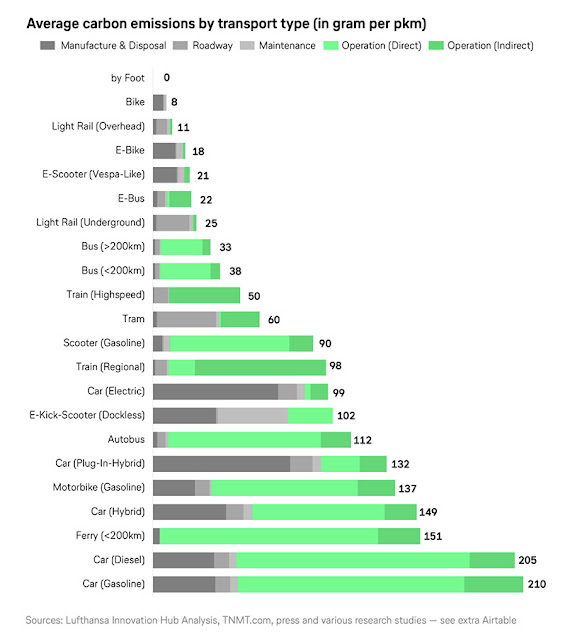
The chart above shows the relative greenhouse gas emissions for various transportation vehicles. TNMT, a data analysis group of the Lufthansa Innovation Hub aggregates data for the chart with the caveat that the numbers are not exact (for example, cars vary greatly in their gasoline consumption, but an average can be approximated). Emissions are often not obvious; for instance, a vehicle may have low emissions while driven, but the manufacturing of it may produce a lot. The chart is useful for making individual decisions as to vehicle choices or frequency of vehicle use. It shows that we can make big reductions in our carbon footprints if we are deliberate in our use of travel technologies. If we choose to use one for short errands and another for long-distance travel, that will be significantly beneficial. — Steve Price

Two-tier mobility

Image
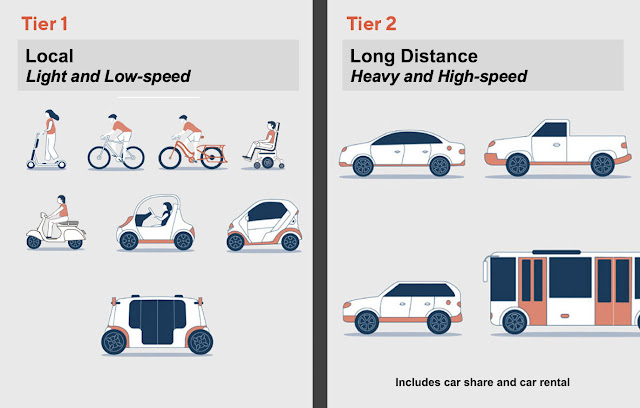
Illustration adapted from the book Near to Far by Dan Sturges. Modified with author's permission. By Steve Price The concept of “two-tier mobility” attempts to impose discipline on America's mobility habits, but in a way that acknowledges the value of full-size cars while being more discerning about their use in daily living. Tier 1 vehicles are bicycles, scooters, mopeds, neighborhood electric vehicles (NEVs), and an emerging class of small, autonomous shuttles transporting 8 to 12 passengers at slow speeds. Over 71 percent of travel in America is within a radius of 8 miles or less. This sweeps out an accessible area of over 200 square miles, depending on geographic constraints. Within this nearby but generous zone, seeking out a freeway for travel doesn't save much time. Some Tier 1 vehicles, such as e-mopeds and NEVs, can easily handle traveling 8 miles and back. About two-thirds of travel is 5 miles or less, which is easily done by bicycle. At 12 to 15 mph, that would ...

New rules for bike and pedestrian safety

Beginning January 1, 2024, bikes are allowed on most of the escalators throughout the BART system to help make it easier for people to bring their bikes on board the train. This change was approved by the BART Board of Directors at the request of Director Rebecca Saltzman, an El Cerrito resident. The vote authorizes further changes to BART’s bike rules, including allowing bikes on all train cars except the first car (bikes were previously banned from the first three cars during commute times), and allowing bicyclists to secure bikes on the train using the bike lean bar and straps, instead of holding them. Bikes will remain banned from BART’s 10 narrow escalators located at the 19th Street Oakland, Antioch, and Oakland Airport Connector stations. A video with safety tips for bringing bikes on escalators and the updated Bikes on BART rules are here . Bonus! Check out BART’s Elevator Dimension Guide for assistance with navigating BART elevators. Several new laws also went into effect in ...

El Cerrito sustainable transportation update

Image
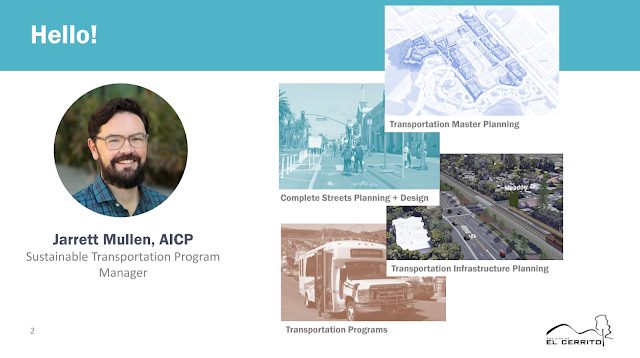
 At our Jan. 15 meeting, Jarrett Mullen, El Cerrito’s sustainable transportation manager, gave EC/RA Walk & Roll an update on current projects and future plans for improving multimobility around town. Mullen shared that the El Cerrito Public Works department filled two traffic engineering positions and secured $20+ million in transportation grants; the Del Norte Complete Streets program will break ground in March; a Local Road Safety Plan is underway; and the GIG CarShare pilot has been extended through 2024. Projects underway in 2024 include growing the city’s bicycle parking program and moving forward with the El Cerrito Plaza BART Station transit-oriented development project and BART’s Berkeley-El Cerrito Corridor Access Plan . Mullen’s presentation is here and the Zoom recording of his presentation and follow-up questions is here .

Swimming with Leviathans

Image
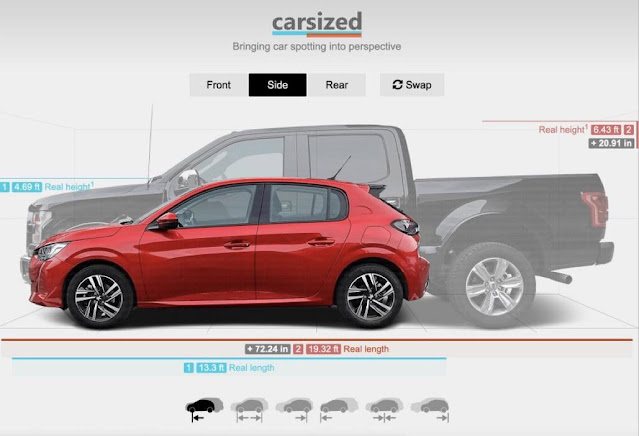
By Steve Price Automobiles are taking up more and more space on our local streets—they're getting bigger and heavier. Light trucks, which include SUVs, vans, and pickup trucks, were 33% of the new vehicle market in 1990; they're now 78%. Average horsepower for light-duty vehicles grew by 85% between 1975 and 2021. This targets the most dangerous vehicle users, young men.  The top-selling vehicle in America is the Ford F-Series pickup. Compare that with the modest-sized best selling car in Europe, the Peugeot 208. (See the comparison in the graphic above from carsized.com.) For older communities like El Cerrito and the Richmond Annex, where street space is not growing, this car bloat puts more and more squeeze on bicycle riders and makes crossing streets for pedestrians more dangerous. As cars get electrified, they will get heavier, which means that they will be deadlier at lower speeds. The taller the front end of a vehicle, the more deadly it is. Low front ends, as typical in ...

What governments are doing about car bloat

Image
With cars and trucks getting heavier and more powerful, some governments are taking measures to address this growing concern. ​​Anne Hidalgo, the mayor of Paris, France wants to “stop the excesses of carmakers, who are pushing people to buy ever bigger, more expensive, more raw-material-intensive, more polluting vehicles.” She has set up a referendum for Parisians to vote in February 2024 for parking-fee increases for SUVs and trucks. Washington, DC, is substantially increasing annual registration fees for heavier vehicles. At $500, the annual fee for a vehicle over 6,000 pounds, will be seven times more than for a smaller car. The fee for vehicles less than 3,500 pounds, $72, remains unchanged. In California, Governor Gavin Newsom recently signed AB 251 , authorizing a study of the effects of vehicle weight on pedestrian and bicycle rider safety, and exploring the possibility of a passenger vehicle weight fee. In the European Union, Australia, China, Korea, and Japan, vehicles are t...

Parking structures stressed by heavier vehicles

Image
Structured parking is envisioned as part of the development at the El Cerrito Plaza BART station. How will its design respond to an evolving vehicle future? As automobiles get larger, cities will be under pressure to change parking to accommodate the growing sizes, which means more asphalt and concrete. There are serious questions about whether existing parking garages can hold the extra weight of American vehicles going forward. Structural engineers in the United Kingdom are expressing concerns about the impact on parking garages of heavier, electrified cars. Electrified American cars are bigger still. The concrete industry is responsible for 8% of carbon dioxide emissions worldwide. We will likely need to use more concrete in future parking garages given vehicle bloat. Hopefully emissions from concrete and steel manufacturing can be reduced, which, if improved processes can be developed, will nevertheless take time to scale up. Meanwhile other solutions: Make parking spaces bigger ...

Pedestrian hybrid beacons: There’s a new kind of traffic signal in town; here’s what you need to know.

Image
If you’ve driven, walked, or rolled along San Pablo Avenue recently, you may have noticed a new type of traffic signal at the San Pablo Avenue and Eureka Avenue intersection. Installed by Caltrans, the signal is called a pedestrian hybrid beacon or PHB, and is a special type of traffic signal that reduces pedestrian-vehicle conflicts on busy roadways. A before and after study of pedestrian hybrid beacons in Tucson, Arizona, identified a 29 percent reduction in total crashes and a 69 percent reduction in pedestrian crashes. Learn more on the City of El Cerrito website .

Art-infused bike parking coming to town

Image
On Dec. 4, Jarrett Mullen, El Cerrito’s sustainable transportation program manager, gave a presentation to the city’s Arts and Culture Commission, which proposed a public art project linked to new bike parking corrals. The proposed art program would integrate work by local artists into on-street bike parking facilities, in order to help the city to achieve its overlapping goals of placemaking, increased access to public art, improved sustainability, expanded business access options for customers and employees, and leveraging of transportation resources. “The commission essentially directed staff to develop a ‘call for artists’ process for pavement artwork that we could package with on-street bike corrals. This is something staff will be working on in 2024!” Mullen noted. In the December 4 art commission meeting agenda , scroll down to item 6 to see Mullen’s full presentation. Photo: Bike parking with public art could be coming soon to El Cerrito.

Show your support for a multimodal transportation future

Image
There is so much at stake. Act to make a world of difference. If you support multimodal mobility in our area, we urge you to sign the following petition .

HURRAH FOR BIKE RACKS! Little Lamb Bilingual Preschool

Image
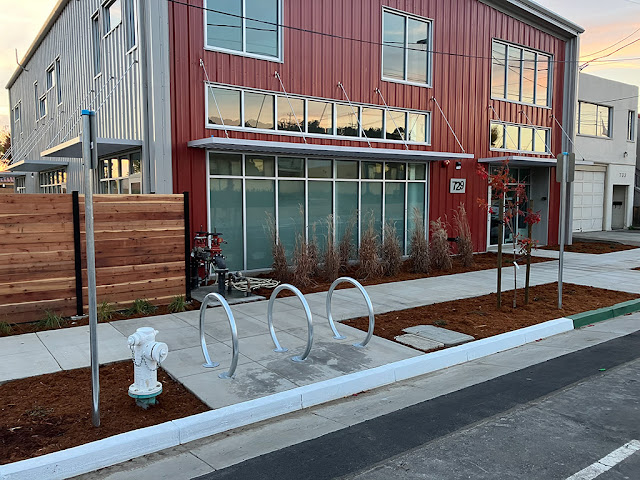
Newly constructed Little Lamb Bilingual Preschool with bike racks Schools should have bike racks. It doesn't seem like rocket science, yet it is surprising how lacking they often are at schools. The Little Lamb Bilingual Preschool will soon open to children on Kearney Avenue across the street from Fairmont School. Preschool children are probably too young to bicycle alone to school; they will be dropped off by their parents. Increasingly we're seeing parents delivering their children to schools by electric cargo bicycles. Having short-term bicycle parking racks to secure parents' bikes while they shuttle their little ones into the school building makes sense. Electric cargo bikes are not cheap and deserve sturdy and secure racks. Little Lamb deserves kudos for respecting and encouraging this simple transportation need. —  Steve Price

Safe Routes to El Cerrito Schools: Let’s make it easy for kids to get to school the smart and healthy way

Image
By Stuart Sonatina El Cerrito has about 25,000 people, 4,500 of whom are under 18. Every weekday they get up and go to one of our approximately 15 schools, which in our city of 3.67 square miles is typically less than a mile away. That’s less than a 20-minute walk or a 4- to 8-minute bike ride. Instead of benefitting from those few minutes of fresh air and exercise, many children are immobile in a car seat for their twice-daily commute. It’s hard to blame their parents for choosing to drive their children to school instead of letting them walk or bike; after all, over 110 Americans are killed by a car every day . There are numerous benefits (both short and long term) to walking or biking to school. These include improvements to mental and physical health, better sleep, and increased performance in school, to name a few. Unfortunately, the United States has seen fewer and fewer students getting to school under their own power over the past several decades. This creates a vicious cycle...

Local Road Safety Plan for El Cerrito

Image
The City of El Cerrito has embarked on developing a Local Road Safety Plan (LRSP) with the help of consultants Kittelson & Associates . A Local Road Safety Plan results in an implementable plan with strategies, actions, and projects focused on reducing crashes on City roadways—particularly fatal and serious injury crashes. The plan team completed a 5-year crash data review and found that of the 10 fatal and severe crashes during this period, 7 involved bicyclists and pedestrians, indicating a potential need to focus on the needs of vulnerable road users, among other trends. Travel safety is dependent on three major things: how dangerous vehicles are to the occupants and people outside the vehicle, street design, and the behaviors of people. The physical design of our streets is clearly within the responsibility of local government. By making investments in physical improvements to our streets, the city can increase local transportation safety. With the Local Road Safety Plan in ha...

Screening of The Street Project documentary well attended

Image
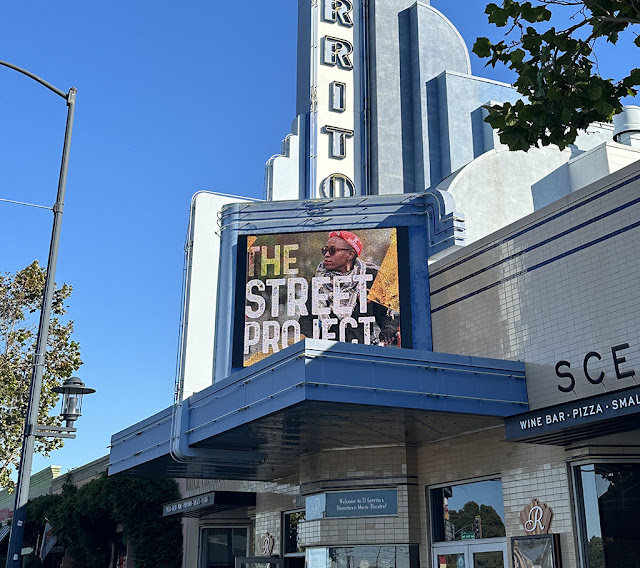
On Saturday, October 7, over 45 people attended the screening of The Street Project , a documentary about making our streets safer for cyclists and pedestrians. The free event was sponsored by El Cerrito Stollers & Rollers (now EC/RA Walk & Roll), El Cerrito Environmental Quality Committee, Bike East Bay and hosted by Rialto Cinemas Cerrito.  The 52-minute documentary was followed by presentations by Steve Price of El Cerrito Strollers & Rollers (now EC/RA Walk & Roll); Howdy Goudey of the El Cerrito Environmental Quality Committee; Jarrett Mullen, El Cerrito's Sustainable Transportation Program Manager; and Robert Prinz of Bike East Bay. Immediately afterward, participants met for lunch and lively group discussions at Tigon Vietnamese Restaurant. Attendees were excited to learn more about safe streets for walkers and bikers and El Cerrito’s future multimodal transportation plans.  If you missed The Street Project showing at Rialto Cinemas Cerrito, you can watc...